
The Psyber Self - Who You Become Online vs. Who You Are
Caleb Altesleben, M.A.
The Psyber Self - Who You Become Online vs. Who You Are
Caleb Altesleben, M.A.
7/28/2026


You've rewritten a caption. Not for accuracy — for tone. You've taken eleven photos of the same thing and picked the one where you looked least like yourself and most like yourself.
Nobody made you do that. You did it in about four seconds, without deciding to, for an audience you weren't consciously thinking about. That reflex has a name, and it's older than the internet.
Everybody's Onstage
In 1959, a sociologist named Erving Goffman wrote a book arguing that ordinary life is theater. Not as an insult — as a mechanic.
He described a front stage, where you perform a version of yourself calibrated to your audience, and a back stage, where you drop it. The waiter is charming at your table and exhausted in the kitchen. The teacher is authoritative in class and unsure in the car. Neither one is lying. They're doing what humans have always done: adjusting the presentation to fit the room.
Goffman was writing about dinner parties and hospital wards. He had no idea he was drafting the manual for Instagram.
Because here's what changed. In Goffman's world, the front stage had walls. You performed for the people in the room, then the room emptied and you got your face back. The performance was bounded — by time, by place, by the physical fact that the audience went home.
Yours doesn't have walls. The audience never goes home.
Goffman's front stage had a curtain. Yours has a notification bell.
The Self That Never Gets to Rest
Think about what your profile actually is. It's a front stage that runs twenty-four hours a day, is visible to everyone you've ever met simultaneously, and keeps a permanent record.
Three things follow from that, and none of them are small.
It's always on. The waiter's shift ends. Your profile is being viewed while you sleep, and it's still performing, and you're still — somewhere in the back of your mind — accountable for it. There's no kitchen to retreat to.
The audiences collapse. In physical life you had separate rooms: work you, family you, old-friends you, 3-a.m. you. Different rooms, different performances, no conflict. Online, your boss, your mother, your ex, and your college roommate are all in the same room watching the same performance. So you flatten. You perform the version that's safe for everyone, which is usually the version that's fully true for no one.
It's permanent. A dinner party performance evaporates. This one gets archived, timestamped, and is searchable by a person you haven't met yet.
Maintaining that is work. Not dramatic work — quiet, constant, mostly invisible work. And most people never notice they're doing it, which is exactly what makes it exhausting.
The Gap
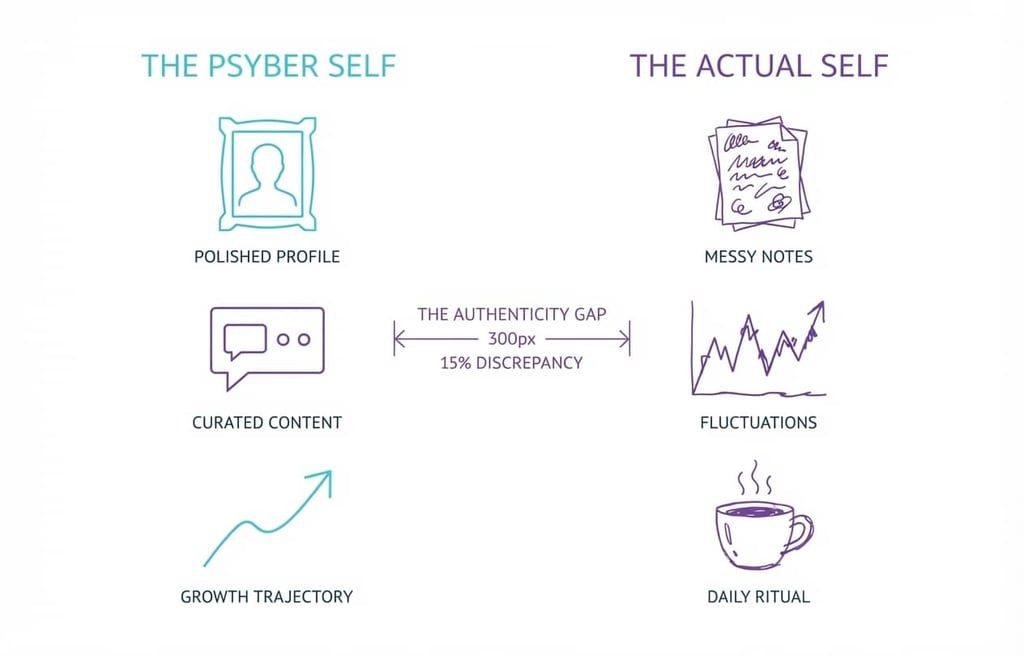
So there are two of you now, and it's worth being precise about the difference.
There's the psyber self: the curated, edited, best-angle version. The one with the good captions and the coherent narrative and the reasonable opinions. And there's the actual self: messier, more contradictory, occasionally petty, frequently bored, currently in sweatpants.
The psyber self isn't fake. That's the thing people get wrong about this. It's made of true things — real photos, real opinions, real moments. It's not a lie. It's a selection. Which is arguably more insidious, because you can't catch yourself in it. Nothing there is untrue. It's just that the parts of you that didn't make the cut don't appear anywhere, including in your own review of who you've been lately.
And the gap between the two selves is where the cost lives. Not because having a public face is bad — you've always had one. But because this one requires constant maintenance, and the maintenance runs on a loop you can't see.
When You Start Believing the Edit
Here's where Sherry Turkle's warning gets uncomfortable.
Her concern was never that we lie online. It's subtler and worse: that we start to prefer the edited version — and slowly lose our tolerance for the unedited one. Including our own.
Watch how that works. You post the good version. It gets a response. The response feels good, and it's attached specifically to the curated you — not the sweatpants one. Do that a few thousand times and your sense of who's worth being starts quietly drifting toward whichever version gets the reaction.
The edited self gets the applause. Then you start wondering why the real one feels like a disappointment.
That's the actual mechanism behind a lot of what gets loosely called "social media makes you feel bad." It isn't only that you're comparing yourself to other people's highlight reels — though you are. It's that you're comparing yourself to your own. You've built a version of you that's more interesting, more resolved, and more photogenic than the person doing the building, and then you have to go on living as the person.
The comparison you lose most often is the one against yourself.
What This Means
The reframe here isn't delete your profile and be authentic. That's a fantasy, and honestly a slightly self-righteous one. Humans have performed identity in every society we've ever recorded. Presenting a curated self isn't a modern sickness; it's a social skill.
The problem is structural, not moral. The performance lost its walls, its separate rooms, and its off switch. So the fix isn't to stop performing. It's to rebuild the walls the technology removed — and to stay conscious of which self you're currently being.
Getting Your Back Stage Back
Notice when you're performing. Not to stop it — just to know. The caption rewrite, the photo selection, the post you drafted and deleted because it wasn't "you." That's stagecraft. It's fine. It's only costly when it's invisible.
Rebuild separate rooms. Different platforms for different audiences. Close friends lists. Group chats instead of broadcasts. Every audience you separate is one less flattening compromise you have to make.
Protect an unaudienced space. Something you do that nobody sees and nothing records — a walk with no photo, a hobby you're bad at, a journal nobody reads. Not for wellness-points reasons, but because a self that's never off-stage stops knowing what it likes when nobody's watching.
Post something unresolved. Occasionally let the version you publish be less finished than you'd prefer. Not as confession-content — as calibration. It keeps the gap from widening.
Ask which self you're maintaining for. Some of the performance is for people you care about, and that's connection. Some of it is for an abstract audience that isn't actually watching. That second one is the expensive kind, and it's usually the larger share.
The Move
You're going to keep performing. So did every human before you, and Goffman would've told you that's not a flaw — it's how social life works.
The question worth carrying is narrower: do you still know which one you're being?
Because the risk was never having two selves. It's forgetting which one you go home to — and quietly starting to prefer the one that photographs well.
Want to actually map the gap? The Cyberpsychology Survival Workbook ($12) includes the Psyber Self Portrait — a guided exercise that puts the curated self and the actual self side by side on paper, where the difference is a lot harder to ignore. It's the most uncomfortable page in the workbook, and the one people tell me about most.

Exploring how technology shapes human behavior — and how to take the controls back.
Explore
Tools
Connect
© 2026 PsyberPsychology. All rights reserved.